
Customer story · Healthcare & Life Sciences
Making Improvements in Fax Communications
One of Canada's oldest and largest private healthcare organizations replaced over-provisioned PRI circuits and SBC gateways serving its fax server with Cloudli T.38 SIP trunks, gaining active/active high availability and lower telecom costs.
 Published by Cloudli
About A large private home healthcare organization in Canada
The client is one of Canada's oldest and largest private healthcare organizations. For 110 years it has delivered in-home care through dedicated healthcare professionals, and it uses information technology at the enterprise level to support service delivery. With a large distributed workforce and high costs of providing services, the organization is always interested in improving efficiency and reducing costs while increasing fault tolerance and disaster recovery capability, because when health is at stake, disruptions in technology can be devastating.
The challenge
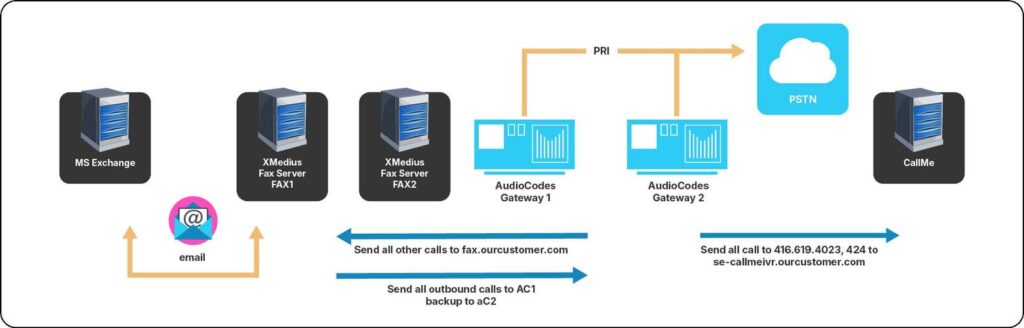
As in many healthcare organizations, fax plays a large role at the client. Inbound and outbound fax are critical to the deployment, tracking and billing of its healthcare professionals. Until recently, the fax infrastructure was a hybrid deployment: both inbound and outbound faxes were delivered via email using an OpenText fax server, while fax calls were carried over standard PRI circuits from a major telecommunications provider.
The design had served for many years but suffered from four limitations. Failover was a manual process requiring human intervention, and the primary/backup fax server configuration could cause synchronization issues when returning to normal operation. To handle multiple voice applications on the PRI circuits, two physical Session Border Controller (SBC) gateways routed inbound and outbound voice and fax traffic, acting essentially as multiplexers and adding another layer of complexity.
Capacity was significantly overbuilt. To achieve fault tolerance, two full PRI circuits were in place, for a total of 46 available channels, when volume calculations showed that a fraction of that would be more than enough to handle all voice and fax traffic. Largely because of that over-provisioning and the expensive SBCs, the fax system incurred significant usage and support costs.
The solution
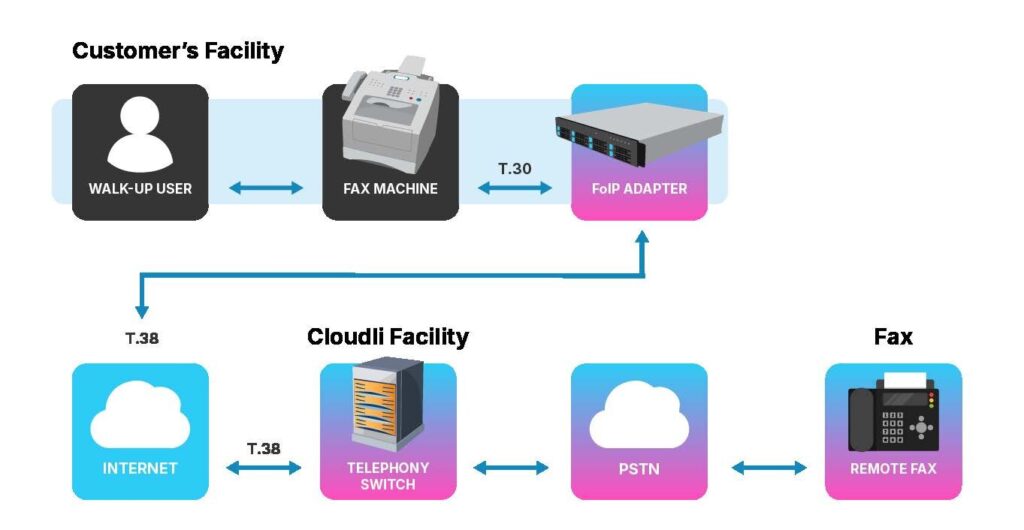
The organization decided to investigate T.38 Session Initiation Protocol (SIP) trunks from Cloudli Communications as a replacement for its expensive PRI circuits. T.38 is the ITU-recommended standard for real-time transmission of fax over IP networks (FoIP), and it offers significant advantages for healthcare organizations that must maintain strict security over private patient health information.
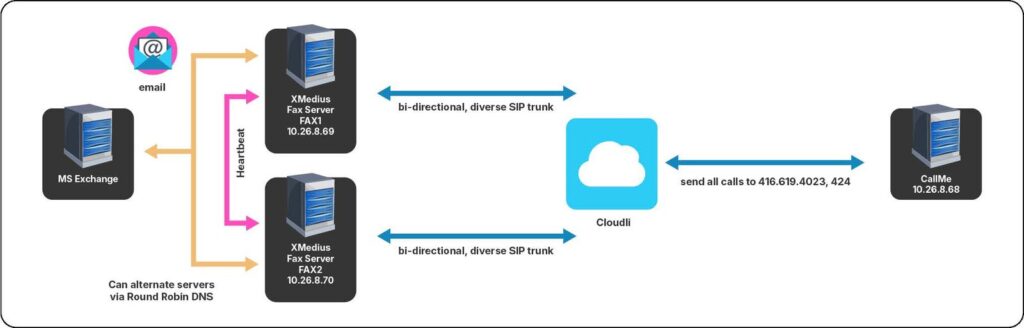
After a short pilot phase that included exhaustive performance testing, the organization adopted Cloudli's SIP trunking design. In the original design, the fax server sent and received faxes over PRI lines via an SBC gateway. Now faxes travel over Cloudli's T.38 SIP trunks, which the fax server supports natively, so the legacy analog PRI lines previously used for fax transmission were eliminated. Because the trunks connect directly to the fax server, the SBCs were decommissioned, saving time and money on infrastructure management and maintenance.
SIP trunks support active/active connections, which PRI circuits cannot. On implementation, the organization moved from a primary/standby configuration to a high-availability active/active design with automated failover and built-in load balancing, enabled through simple license key and configuration changes. The organization also eliminated its physical server equipment and the associated hardware maintenance costs and complexity, and the software-based architecture gives the mission-critical fax service greater resilience and reliability. Cloudli's solution uses standard internet protocols and connections rather than proprietary systems or point-to-point circuits.
The results
- Legacy analog PRI lines used for fax transmission eliminated, along with two full PRI circuits
- Two SBC gateways decommissioned, removing design complexity and two vendors from the support matrix
- Fax service moved from manual primary/backup failover to active/active high availability with load balancing
- SIP trunk channels can be increased or decreased as needed and sized precisely to business need
- Significant reduction in hard telecom and support costs, the main driver of the project
- Physical fax server equipment eliminated, along with its hardware maintenance costs and complexity
Get the full case study
Download the original document as published by Cloudli (PDF, 554.1 KB).
More customer stories
Results from similar engagements

Cloudli · Healthcare & Life Sciences
Academic health system cuts fax failures to near zero with Cloudli
Read more
Foresite · Healthcare & Life Sciences
hMetrix modernizes security operations with Foresite and Google SecOps
Read more
Krisp · Healthcare & Life Sciences
AMI sharpens outbound sales calls with Krisp AI Accent Conversion
Read moreYour story could be next
Want results like these?
Every result on this page started with one conversation — let's have yours.