
Customer story · Retail & E-commerce
Improving Efficiency of Fraud Check Process for a Grocery Delivery Service
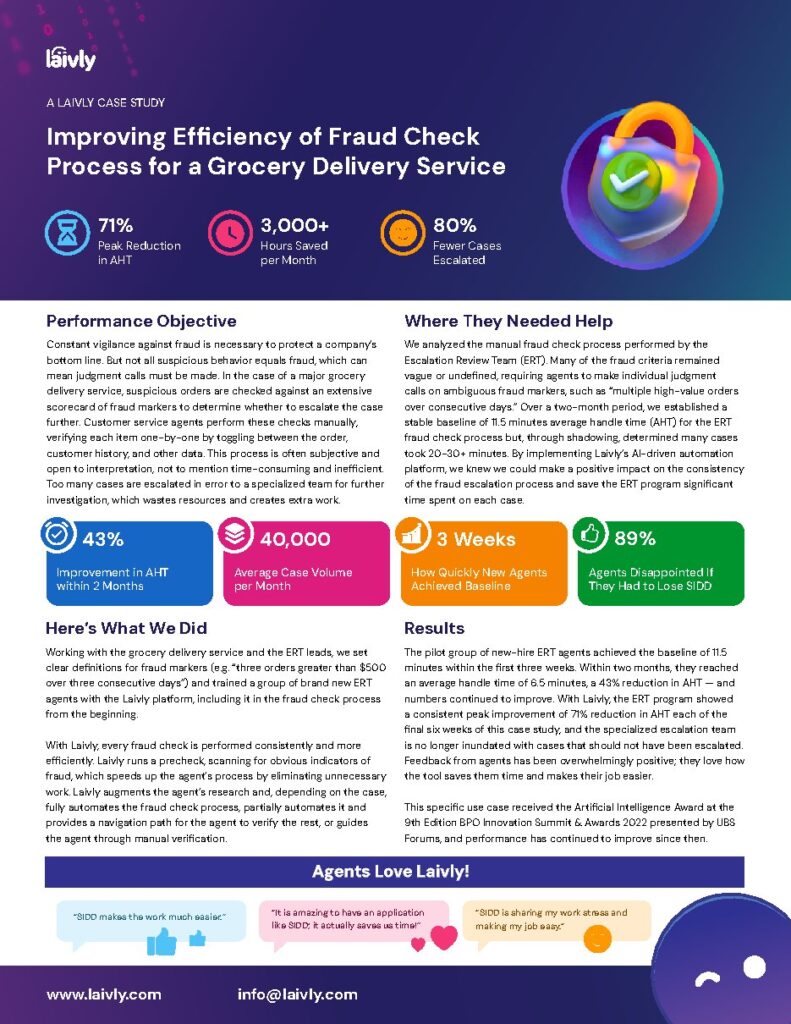
A major grocery delivery service used Laivly's AI-driven automation platform to standardize its manual fraud check process, cutting average handle time 43% within two months, reaching a 71% peak reduction and escalating 80% fewer cases.
About A major grocery delivery service
The client is a major grocery delivery service that screens suspicious orders against an extensive scorecard of fraud markers to decide whether a case should be escalated for further investigation. Its Escalation Review Team (ERT) of customer service agents performs these checks manually, handling an average volume of around 40,000 cases per month by toggling between the order, customer history and other data.
The challenge
Constant vigilance against fraud is necessary to protect a company's bottom line, but not all suspicious behavior equals fraud, which means judgment calls must be made. At this grocery delivery service, suspicious orders are checked against an extensive scorecard of fraud markers to determine whether to escalate the case. Customer service agents on the Escalation Review Team (ERT) performed these checks manually, verifying each item one by one by toggling between the order, customer history and other data. The process was subjective, open to interpretation, time-consuming and inefficient, and too many cases were escalated in error to a specialized team for further investigation, wasting resources and creating extra work.
Laivly's analysis found that many of the fraud criteria remained vague or undefined, requiring agents to make individual judgment calls on ambiguous markers such as "multiple high-value orders over consecutive days." Over a two-month period, Laivly established a stable baseline of 11.5 minutes average handle time (AHT) for the ERT fraud check process, but shadowing showed that many cases took 20 to 30 minutes or more. The opportunity was to improve the consistency of the fraud escalation process and save the ERT program significant time on each of its roughly 40,000 monthly cases.
It is amazing to have an application like SIDD; it actually saves us time!
The solution
Working with the grocery delivery service and the ERT leads, Laivly first set clear definitions for fraud markers, for example "three orders greater than $500 over three consecutive days" in place of the previously ambiguous criteria. It then trained a group of brand-new ERT agents on the Laivly platform, building it into the fraud check process from the beginning of their tenure.
With Laivly, every fraud check is performed consistently and more efficiently. The platform runs a precheck that scans for obvious indicators of fraud, which speeds up the agent's work by eliminating unnecessary steps. Laivly then augments the agent's research and, depending on the case, fully automates the fraud check, partially automates it and provides a navigation path for the agent to verify the rest, or guides the agent through manual verification. Agents refer to the assistant as SIDD.
The pilot group of new-hire ERT agents reached the 11.5-minute baseline within the first three weeks. Within two months they averaged 6.5 minutes per case, a 43% reduction in AHT, and the numbers continued to improve, with a consistent peak improvement of 71% in each of the final six weeks of the study. The specialized escalation team is no longer inundated with cases that should not have been escalated. This use case received the Artificial Intelligence Award at the 9th Edition BPO Innovation Summit & Awards 2022, presented by UBS Forums, and Laivly reports that performance has continued to improve since then.
The results
- 43% improvement in average handle time within two months, from 11.5 to 6.5 minutes per case
- 71% peak reduction in AHT, sustained in each of the final six weeks of the study
- 3,000+ hours saved per month across an average volume of 40,000 cases
- 80% fewer cases escalated to the specialized investigation team
- New agents reached the 11.5-minute baseline within three weeks of starting
- 89% of agents said they would be disappointed if they had to lose SIDD
Get the full case study
Download the original document as published by Laivly (PDF, 305.4 KB).
More customer stories
Results from similar engagements
Laivly · Retail & E-commerce
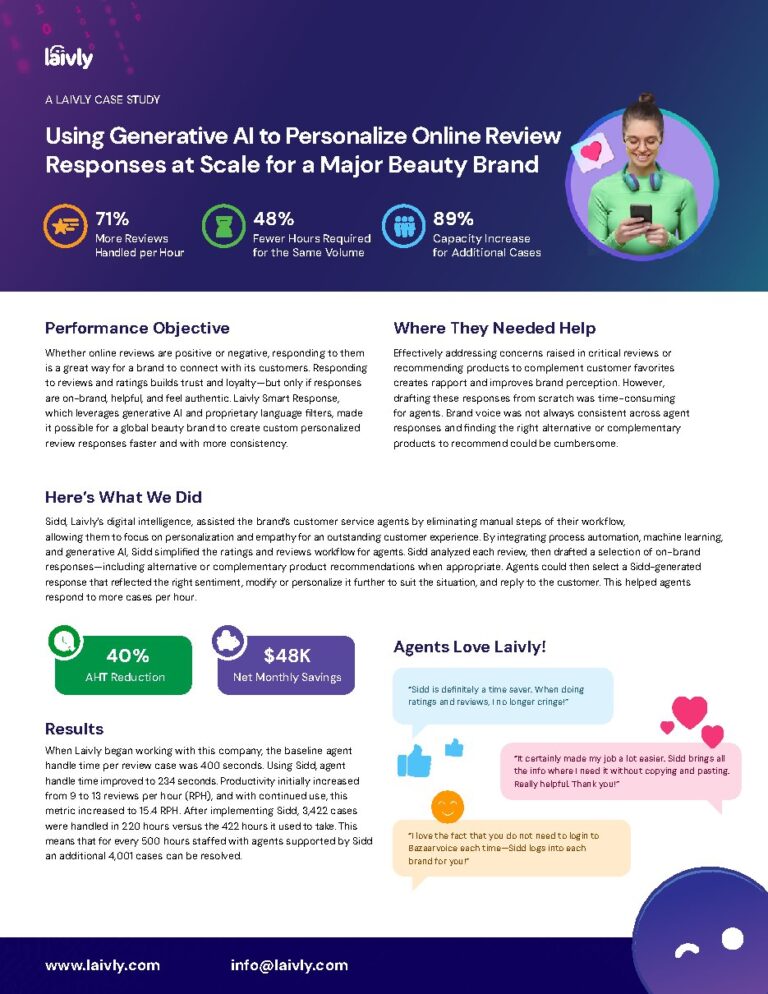
Major beauty brand answers 71% more reviews per hour with Laivly Sidd
Read more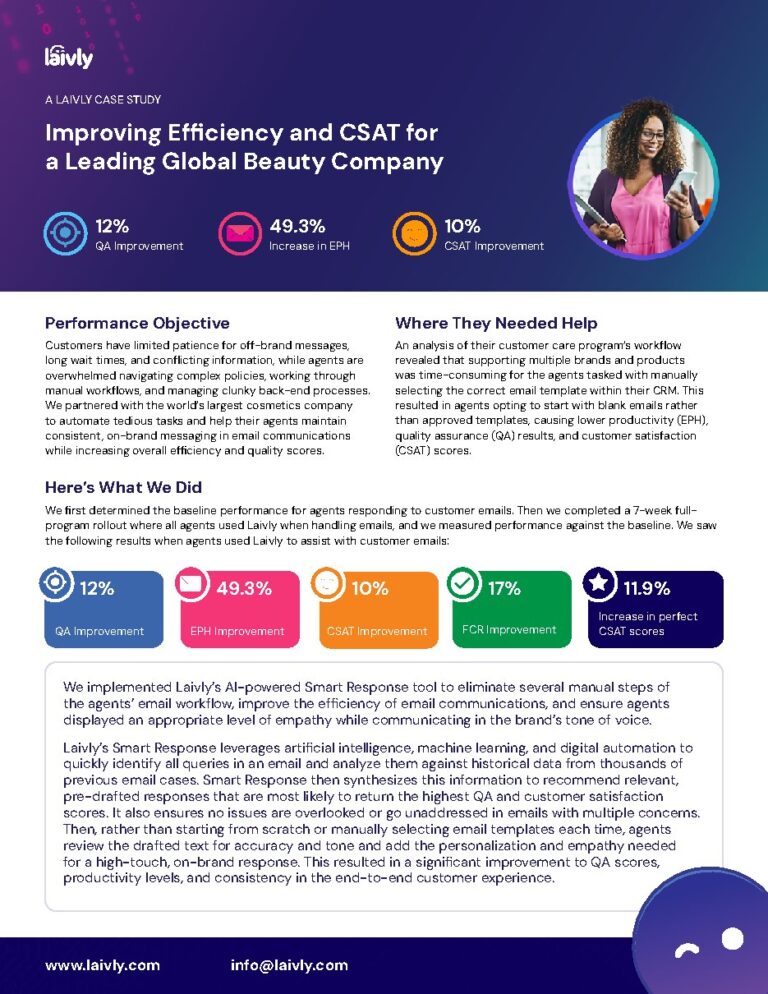
Laivly · Retail & E-commerce
Beauty leader lifts emails per hour 49.3% with Laivly Smart Response
Read more
Your story could be next
Want results like these?
Every result on this page started with one conversation — let's have yours.