
Customer story · Transportation & Logistics
New Jersey Transit Brings Rapid Service to Paratransit Riders With Replicant
NJ TRANSIT's Access Link paratransit program deployed Replicant to automate ride status and cancellation calls, cutting wait times for automated calls to zero and handling 12,000 calls a week.
About NJ TRANSIT
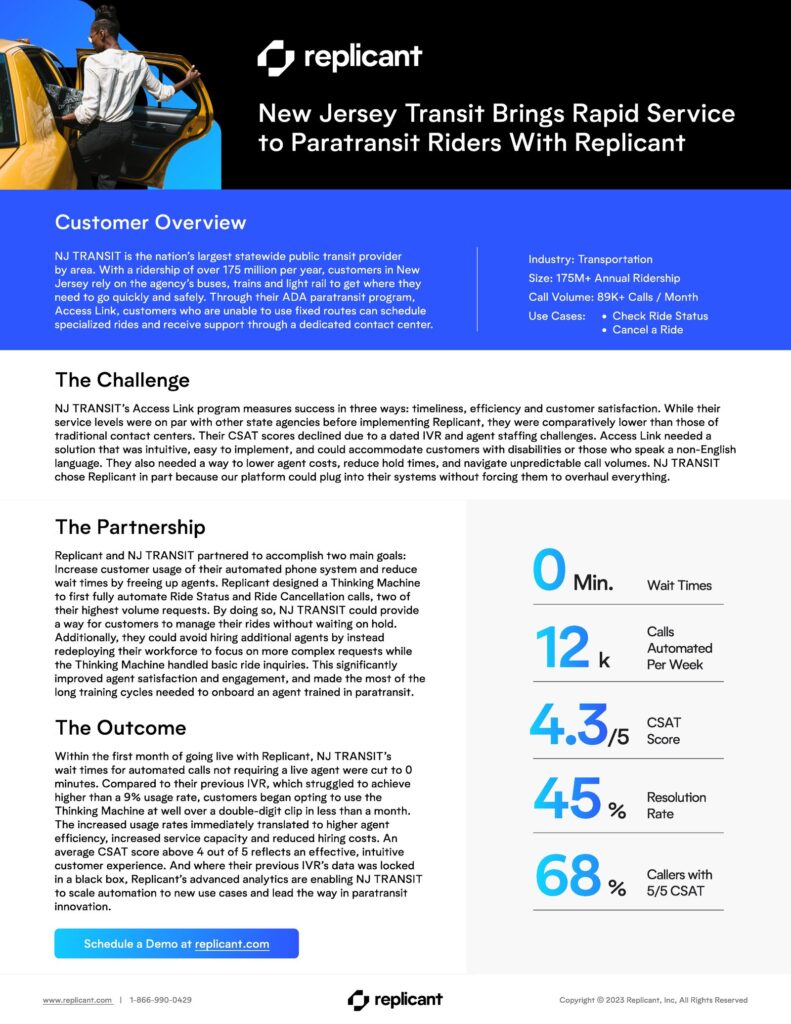
NJ TRANSIT is the nation's largest statewide public transit provider by area. With ridership of over 175 million per year, customers in New Jersey rely on the agency's buses, trains and light rail to get where they need to go. Through its ADA paratransit program, Access Link, customers who are unable to use fixed routes can schedule specialized rides and receive support through a dedicated contact center that handles more than 89,000 calls a month.
The challenge
NJ TRANSIT's Access Link program measures success in three ways: timeliness, efficiency and customer satisfaction. While its service levels were on par with other state agencies, they were comparatively lower than those of traditional contact centers. CSAT scores had declined because of a dated IVR and agent staffing challenges, and the previous IVR struggled to achieve higher than a 9% usage rate.
Access Link needed a solution that was intuitive, easy to implement and able to accommodate customers with disabilities or those who speak a non-English language. It also needed to lower agent costs, reduce hold times and navigate unpredictable call volumes of more than 89,000 calls a month.
Onboarding agents trained in paratransit involves long training cycles, so the agency wanted to make the most of its existing workforce rather than hire more agents. It also wanted a platform that could plug into its systems without forcing an overhaul of everything.
The solution
Replicant and NJ TRANSIT partnered around two goals: increase customer usage of the automated phone system and reduce wait times by freeing up agents. NJ TRANSIT chose Replicant in part because the platform could plug into its existing systems without a wholesale overhaul.
Replicant designed a Thinking Machine to fully automate Ride Status and Ride Cancellation calls, two of Access Link's highest-volume requests. This gave customers a way to manage their rides without waiting on hold, and it let NJ TRANSIT redeploy its workforce to more complex requests instead of hiring additional agents. According to the case study, this significantly improved agent satisfaction and engagement and made the most of the long training cycles needed to onboard a paratransit agent.
Where the previous IVR's data was locked in a black box, Replicant's analytics give NJ TRANSIT visibility into how calls are handled, which the agency is using to scale automation to new use cases and lead the way in paratransit innovation.
The results
- Wait times for automated calls not requiring a live agent cut to 0 minutes within the first month
- 12,000 calls automated per week across Ride Status and Ride Cancellation requests
- Customer opt-in to the Thinking Machine passed a double-digit rate in under a month, versus 9% usage on the old IVR
- Average CSAT score of 4.3 out of 5, with 68% of callers giving a 5/5 rating
- 45% resolution rate, translating into higher agent efficiency, increased service capacity and reduced hiring costs
- Replicant's analytics replaced the old IVR's black-box data, enabling automation of new use cases
Get the full case study
Download the original document as published by Replicant (PDF, 4.5 MB).
More customer stories
Results from similar engagements

Replicant · Energy & Utilities
Sunrun resolves 50% of payment calls with Replicant conversational AI
Read more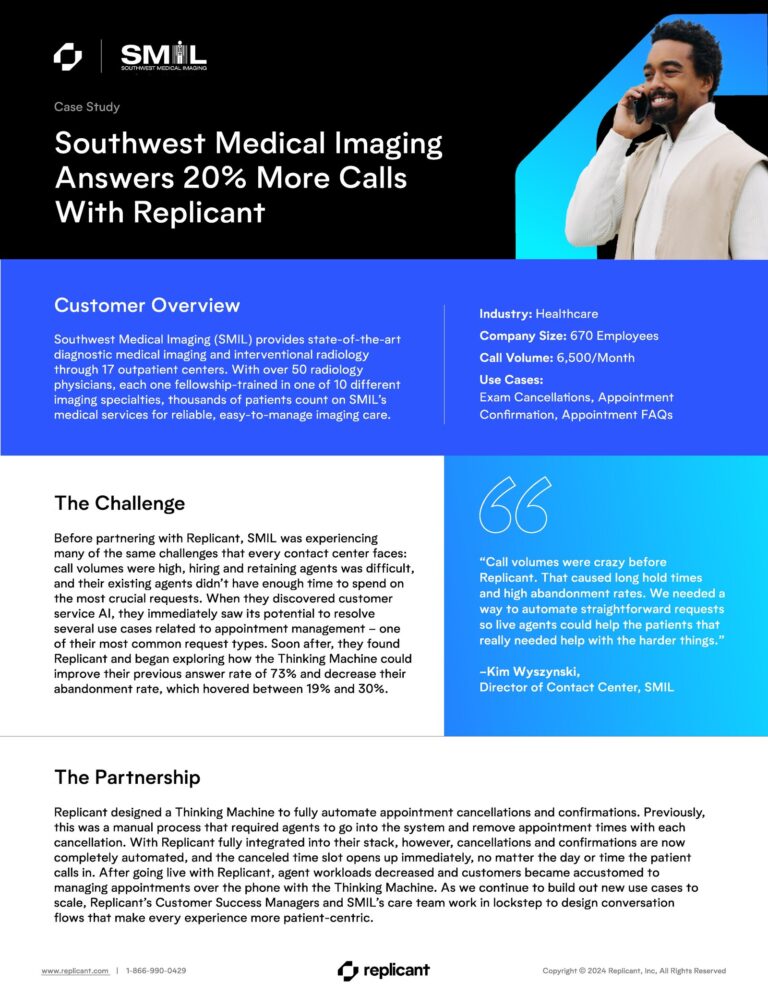
Replicant · Healthcare & Life Sciences
Southwest Medical Imaging answers 20% more calls with Replicant AI
Read more
Replicant · Technology & Software
DoorDash automates 35,000 merchant order calls a day with Replicant
Read moreYour story could be next
Want results like these?
Every result on this page started with one conversation — let's have yours.